How to Repair Cracks in Your Concrete Driveway in Cartersville, GA
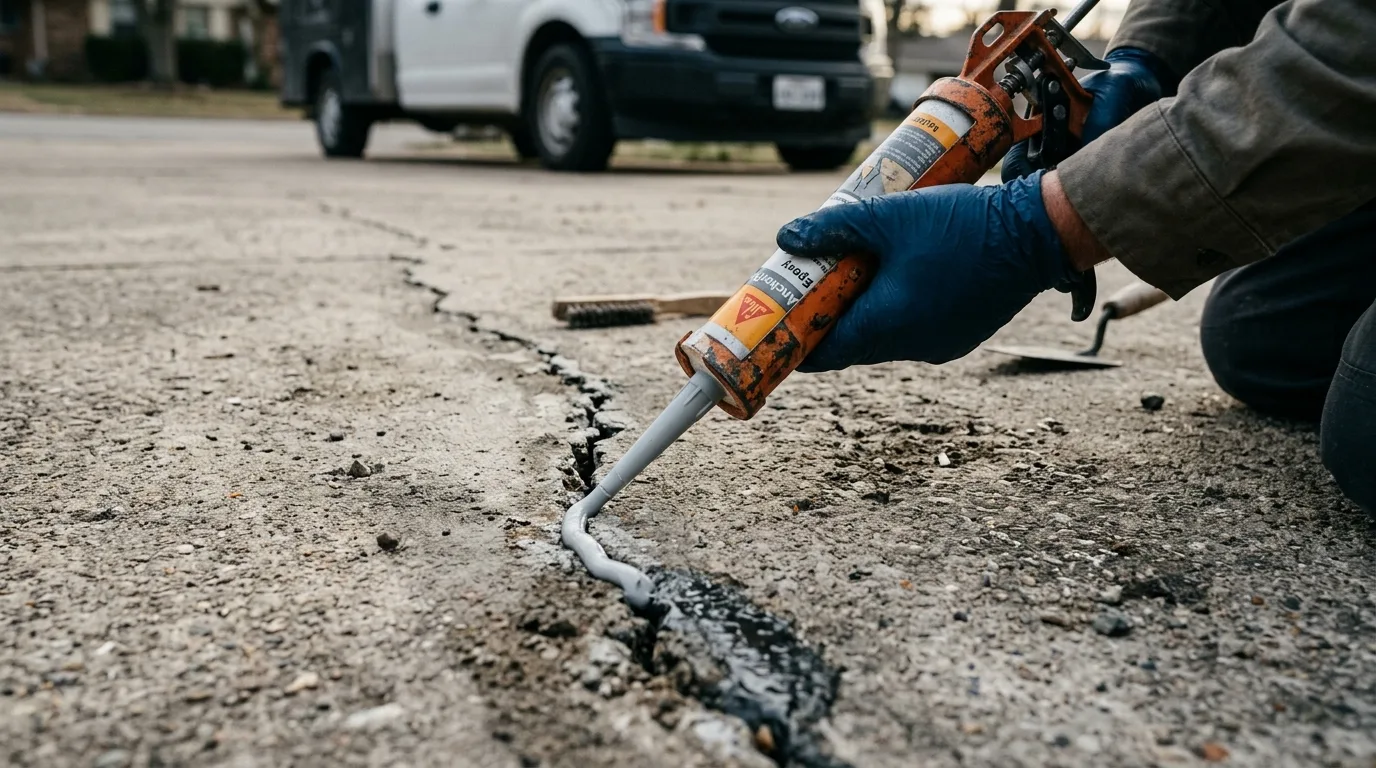
Every spring in Cartersville, homeowners discover new cracks in their concrete driveways that weren’t there in the fall. Bartow County’s winter freeze-thaw cycles open existing micro-cracks and create new ones as water infiltrates, freezes, expands, and fractures the cement matrix. Some of these cracks are cosmetic and manageable with DIY repair products. Others indicate sub-base problems that require professional diagnosis and repair. Knowing the difference determines whether you spend $20 at the hardware store or $500 with a contractor — and whether the repair you make actually holds.
Free Concrete Driveway Crack Assessment in Cartersville
We tell you honestly whether it's a DIY fix or a professional repair. Call (888) 376-0955.
Understanding What Type of Crack You Have
Before attempting any crack repair, classify the crack. In Cartersville driveways, three categories matter:
Hairline surface cracks (under 1/8 inch wide, no depth separation): These are typically caused by surface drying during the initial cure period or by UV-driven surface shrinkage. They are cosmetic rather than structural and can be sealed with a penetrating concrete sealer or a flexible crack filler without professional intervention.
Moderate cracks (1/8 to 3/8 inch wide, may have some depth): These require crack filling with a polyurethane or epoxy-based filler to prevent water infiltration. If the crack is not displacing vertically (one side is not higher than the other), it can often be repaired at the surface level. If the crack is at a control joint, it may be a result of the joint working correctly — fill it with a flexible sealant, not a rigid filler.
Wide or displaced cracks (over 3/8 inch wide, OR any crack with vertical displacement): These indicate structural issues — sub-base failure, differential settlement, or significant clay movement beneath the slab. Surface filling will not solve the underlying problem. These require professional concrete repair assessment to determine whether sub-base correction or slab lifting is needed before any surface work.
When Cartersville’s Climate Makes Crack Repair More Urgent
The reason crack repair urgency is higher in Cartersville than in many other Georgia markets is that Bartow County experiences freeze-thaw cycling from November through March — an annual weather pattern that turns every unsealed crack into a water infiltration point and every water infiltration point into a larger crack the following spring.
Here’s the specific mechanism: water enters a 1/8-inch crack in October. When temperatures drop to 28–30°F in January (common in Cartersville’s winters), that water freezes and expands by about 9% in volume. This expansion forces the concrete at the crack edges apart, widening the crack to 1/4 inch. The cycle repeats through the following winter, eventually widening the crack to 3/8 inch and allowing water to reach the sub-base — where it saturates the red clay and triggers the expansion-contraction cycle that causes structural settlement.
Filling cracks before winter — ideally in September or October — interrupts this annual widening process and keeps manageable cracks from becoming replacement-triggering structural failures. This is the highest-value time-sensitive maintenance task for Cartersville concrete driveways.
DIY Concrete Crack Repair: What Works and What Doesn’t
For hairline and moderate cracks in Cartersville driveways, two product types perform well:
Polyurethane concrete crack filler (products like Sika Flex, Quikrete Non-Sag Polyurethane Sealant): Flexible sealants that bond to the crack edges, fill the void, and flex slightly with the concrete’s seasonal movement. Best for cracks under 1/2 inch wide that don’t have vertical displacement. Apply with a caulking gun, smooth with a putty knife, and allow 24 hours to cure before vehicle traffic.
Concrete epoxy injection (products like Rhino Carbon Fiber Concrete Crack Epoxy): Rigid two-part epoxy that structurally bonds the crack edges together once cured. Best for non-moving, non-displaced cracks where structural bonding is desired. Not appropriate for cracks that are actively moving with temperature and moisture cycling.
What doesn’t work: hydraulic cement, regular mortar, or masonry caulk. These products crack and pop out of concrete driveways quickly because they can’t flex with the slab’s movement and don’t bond durably to the crack edges in wet or dirty conditions.
Surface preparation is critical. Clean cracks with a wire brush and blow or vacuum out all loose material, dust, and organic debris before filling. If the crack is wet, allow it to dry completely. No filler bonds well to dirty or wet surfaces.
Not Sure If Your Cartersville Driveway Cracks Need a Pro?
We provide free, honest assessments — no obligation to hire. Call (888) 376-0955.
When to Call a Professional Concrete Contractor
Several conditions indicate that DIY crack repair will not solve the underlying problem and professional assessment is warranted:
- Vertical displacement: If you can feel a step when you slide your foot across the crack, the slab sections have settled unevenly. This is a structural issue requiring sub-base evaluation.
- Widening cracks: If a crack that you filled last year has reopened or widened, the movement causing it is ongoing. Surface filling will not stop it.
- Multiple cracks in the same section: Three or more cracks in a concentrated area indicate widespread sub-base failure rather than isolated surface damage.
- Cracks near the foundation: Cracks that run toward or parallel to the foundation perimeter may indicate the same soil movement that is affecting your home’s foundation — a more urgent situation.
- Spalling around the crack: If the concrete surface around the crack is flaking or pitting, the damage extends deeper than the crack itself and likely requires resurfacing.
For any of these conditions, the appropriate first step is a professional assessment that evaluates the sub-base and identifies the root cause of the cracking. See our concrete repair service page for what a professional repair assessment involves.
Practical Uses: Types of Crack Repairs in Cartersville
- Sealant fills for control joint cracks: Control joints in Cartersville driveways are designed to crack — the saw-cut provides a weak plane where controlled cracking occurs rather than random surface cracking. When control joint cracks open to 1/4 inch or more, fill them with flexible polyurethane sealant to prevent water infiltration while allowing the joint to continue functioning as designed.
- Epoxy injection for isolated structural cracks: Non-moving cracks in a sound slab (no settlement, no vertical displacement) can be structurally bonded with two-part epoxy injection. This restores some of the tensile continuity across the crack without requiring slab section replacement.
- Resurfacing for widespread surface cracking: When a driveway has multiple shallow cracks from surface shrinkage or light freeze-thaw scaling, full-slab resurfacing with a polymer-modified overlay is more cost-effective than filling dozens of individual cracks.
- Sub-base correction plus slab section replacement: For settled or displaced slab sections, the sub-base void or drainage failure is addressed first, then the affected slab section is replaced to restore level, crack-free surface.
Frequently Asked Questions
Can I fill concrete driveway cracks myself in Cartersville?
For hairline and moderate cracks (under 3/8 inch, no vertical displacement), DIY polyurethane or epoxy crack fillers can be effective and cost-efficient. The critical steps are thorough crack cleaning and surface preparation before filling. For wider cracks, displaced cracks, or situations where the crack has reopened after previous repairs, professional assessment is warranted to identify the root cause before attempting another surface repair. See our guide on concrete driveway maintenance for Cartersville homeowners for the full maintenance picture.
How much does professional crack repair cost in Cartersville?
Professional crack filling for isolated driveway cracks in Cartersville starts at $150–$300. Full resurfacing of a deteriorated driveway runs $3–$7 per square foot. Structural repairs requiring slab lifting or sub-base correction are individually scoped. Georgia’s below-average labor costs keep Bartow County repair pricing competitive. Our concrete cost guide for Cartersville covers repair pricing in full context.
Do I need a permit to repair my concrete driveway in Cartersville?
Surface repairs — crack filling, resurfacing, and sealing — do not require a Bartow County permit. Structural repairs involving removal and replacement of a full slab section may require a permit depending on scope. We evaluate permit requirements during the free assessment for any project that might be subject to them. See our full Bartow County permit guide for more details.
Crack Repair, Resurfacing, and Assessment in Cartersville
Honest evaluation — we tell you if it's DIY-able or not. Call (888) 376-0955 for Bartow County service.
Related guides: