Why Georgia Red Clay Matters for Concrete in Cartersville, GA
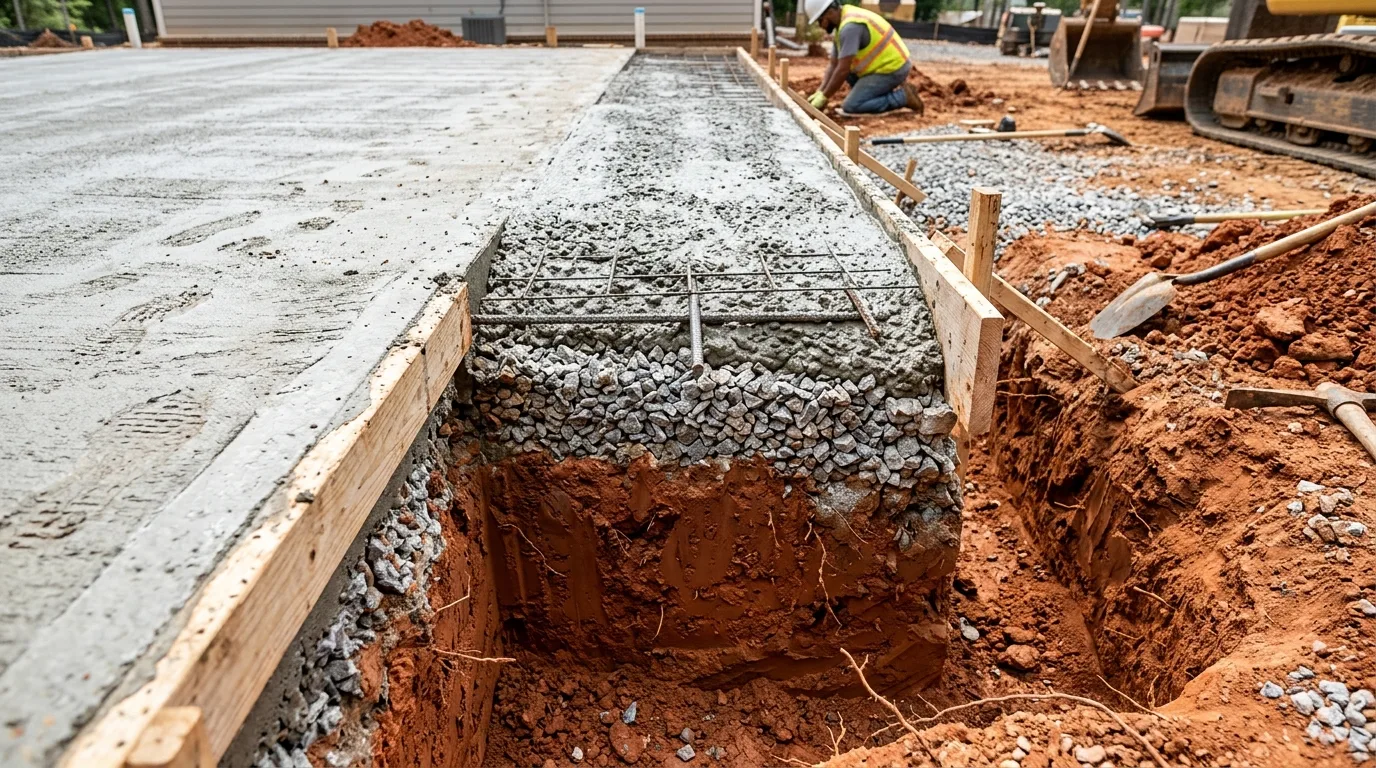
Walk through almost any residential neighborhood in Cartersville — Cedarcrest, Oak Grove, West Cartersville — and you’ll see the same red-orange soil exposed in every disturbed area along the roadside or in new construction lots. That distinctive red clay isn’t just a visual characteristic of the Piedmont region; it’s the single most important factor in determining how well concrete performs on any given property in Bartow County. In this post, we cover what Georgia red clay actually does to concrete, how to prepare properly for it, and why the base preparation under your slab matters more than almost any other factor in your concrete project.
Concrete Built for Bartow County's Red Clay Soil
Every project includes proper gravel base preparation for Georgia's soil conditions. Free estimates at (888) 376-0955.
What Makes Georgia Red Clay Unique
Cartersville sits in the Piedmont physiographic region, where the dominant soil type is an Ultisol — a well-weathered soil with high iron oxide content (the source of the red color) and significant clay mineral content. The clay minerals in this soil are the key: unlike sand or loam, clay particles absorb water and swell, then release water and shrink. This process is called shrink-swell behavior, and it’s the reason concrete installed on unprepared red clay fails far more often than concrete installed on properly prepared bases.
The numbers are significant. Georgia’s Piedmont clay can expand by 5–10% in volume when saturated — a movement that generates substantial upward pressure against the bottom of any concrete slab sitting on top of it. When summer drought dries the same clay, it contracts, creating voids beneath slabs that previously had stable support. The result, repeated year after year, is exactly the pattern of cracking, heaving, and settlement that’s common on driveways and patios throughout Cartersville’s established neighborhoods.
How Red Clay Soil Affects Concrete Driveways
A concrete driveway poured directly on red clay — without adequate base preparation — begins to fail through a predictable sequence. In the first year or two, control joints and surface cracks may appear as the slab responds to sub-base movement. By year three to five, sections begin to crack across their full depth or differential settling becomes visible. By year seven to ten on problem sites, the driveway has reached a state where repair is no longer practical and replacement is required.
The interaction between residential concrete and Bartow County’s Piedmont clay is most pronounced in areas where water drainage concentrates moisture against the slab. Driveways with improper slope that allows water to pool at the base, or those adjacent to planting beds that hold irrigation water against the concrete edge, experience accelerated clay movement and earlier failure than driveways with proper drainage away from the slab on all sides.
Cartersville’s ~42 inches of annual rainfall means that soil moisture cycles are significant even in average years — and above-average rainfall years (which Georgia experiences regularly during La Niña weather patterns) can push soil moisture levels that produce noticeable slab movement even on relatively well-prepared sites.
The Proper Base Preparation for Red Clay Sites
Proper concrete driveway installation on red clay requires a minimum 4-inch layer of clean crushed gravel (typically #57 stone) compacted in lifts to a firm, stable surface. For sites with known drainage problems, clay that is unusually active, or heavy-vehicle applications, 6 inches of gravel is the appropriate specification. A vapor barrier (6-mil polyethylene) installed over the gravel prevents ground moisture from wicking upward into the slab.
These three elements — sufficient gravel depth, proper compaction, and vapor barrier — interrupt the moisture cycle that drives shrink-swell clay movement. The gravel layer provides drainage that keeps clay moisture levels more stable throughout the year, and the vapor barrier reduces the amount of moisture that reaches the clay from surface water infiltration through the slab.
For concrete slabs in garages and outbuildings, the same specifications apply, with the addition that any utility trenches cut through the gravel base must be backfilled with compacted gravel — not the original clay soil — to avoid differential settling where trenches are backfilled with material of different compaction characteristics than the surrounding base.
Proper Base Preparation on Every Concrete Project in Cartersville
We never pour on unprepared clay. Our base prep meets the specifications Bartow County's soil demands.
How Red Clay Affects Foundation Slabs
Foundation issues are common in Cartersville precisely because the clay beneath foundation slabs undergoes the same shrink-swell cycle as the clay beneath driveways — but with consequences that extend to the entire structure above. When the clay beneath one portion of a foundation slab swells and another portion doesn’t (due to uneven moisture distribution from irregular drainage), differential settlement occurs. One section rises while another stays flat or drops, putting the slab in tension and producing the diagonal cracks at door corners and window frames that homeowners recognize as classic foundation movement symptoms.
Foundation repair in Cartersville always begins with a drainage assessment because fixing the structural symptom without correcting the moisture management problem that drives clay movement produces repairs that fail within a few seasons. French drains, downspout extensions, grading corrections, and gutter improvements are often the first step in a foundation repair project — before any concrete work begins.
What to Look For in a Concrete Contractor’s Base Prep
When getting quotes for concrete work in Cartersville, ask every contractor these specific questions about sub-base preparation:
- How many inches of gravel do you install? The answer should be 4 inches minimum, with 5–6 for heavy loads or drainage-challenged sites.
- Do you compact the gravel in lifts? Dumping and spreading gravel without compaction produces a soft base that settles over time.
- Do you install a vapor barrier? Essential for any slab in contact with Bartow County’s moist clay.
- How do you handle drainage at the slab perimeter? The edge of the slab is where clay moisture most directly contacts the concrete — proper edge drainage prevents the edge cracking pattern common on Cartersville driveways.
A contractor who cannot answer these questions specifically — or who dismisses them as unnecessary — is not equipped to build concrete that performs long-term on Georgia red clay.
Frequently Asked Questions
Why does concrete crack so quickly in Georgia?
The most common cause of premature concrete cracking in Cartersville is inadequate sub-base preparation on red clay soil. Contractors who skip or undersize the gravel base allow the expansive clay to directly contact and move the slab, producing cracking within three to seven years. Properly prepared sites with adequate gravel depth and drainage correction last 25–40 years without structural cracking. See our related guide on concrete repair in Cartersville for what to do if cracking has already started.
Can I fix concrete that has cracked due to red clay movement?
Surface and moderate structural cracks can be repaired with crack injection and resurfacing, but the repair will fail again if the underlying clay movement isn’t addressed. The most durable approach is to correct drainage problems first — extend downspouts, regrade around the slab, install French drains where needed — then repair the concrete. Read our concrete repair guide for the full breakdown.
Does red clay affect concrete more than other soil types in Georgia?
Yes — red clay Ultisols produce significantly more shrink-swell movement than the sandy Entisols found in coastal Georgia or the loamy soils in some northern Georgia valleys. Bartow County’s Piedmont clay is among the most reactive soil types in the state for concrete performance. This is why our base preparation specifications for Cartersville projects are more rigorous than what some out-of-area contractors quote.
Concrete That's Built for Georgia Red Clay — Not Just On It
Cartersville Concrete engineers every project for Bartow County's soil. Free estimates at (888) 376-0955.
Related guides: