5 Signs Your Concrete Foundation Needs Repair in Cartersville, GA
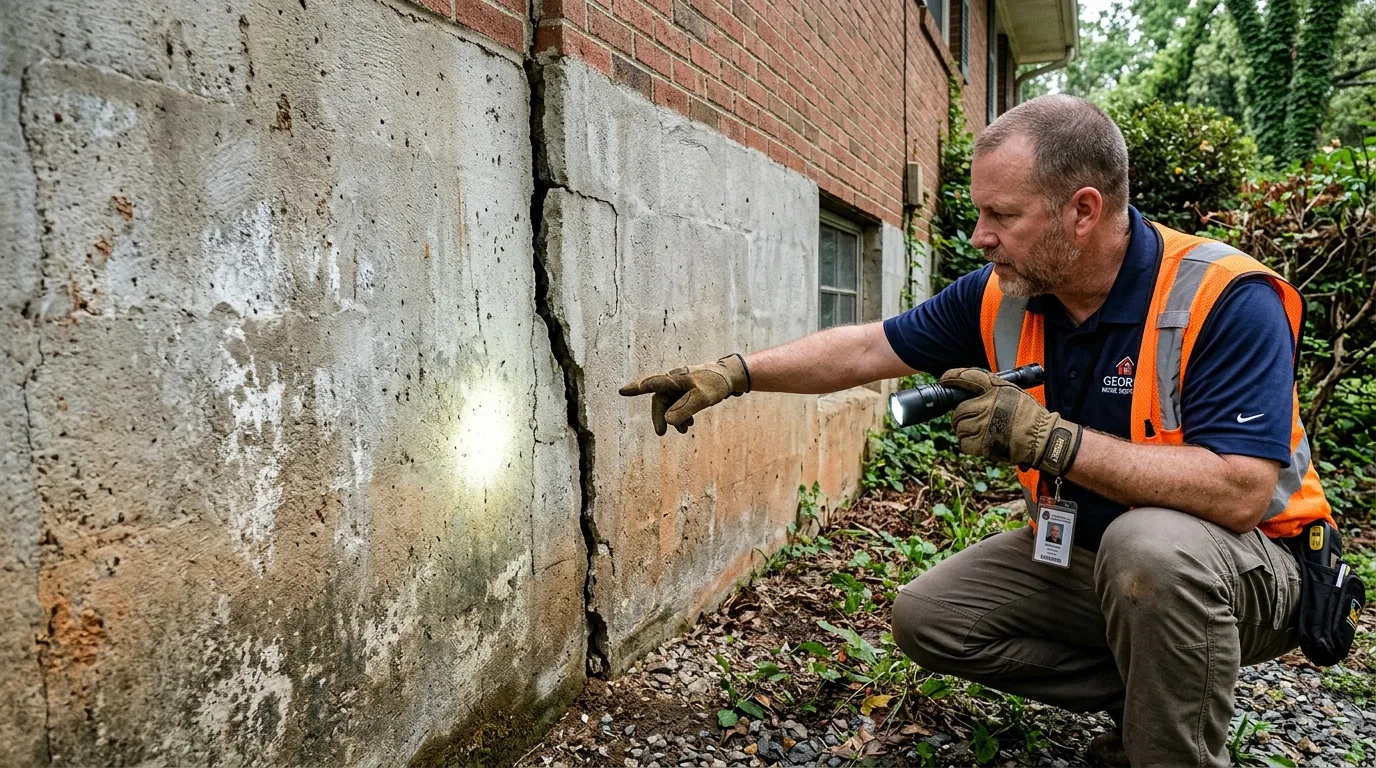
Foundation repair calls in Cartersville spike every spring as homeowners discover damage that developed over the winter. Bartow County’s Piedmont red clay absorbs moisture from autumn rains, freezes and swells during January cold snaps, then dries and shrinks through late spring — a cycle that stresses foundation slabs far more than most homeowners realize until visible symptoms appear. In this post, we cover the five most important warning signs of foundation damage specific to Cartersville homes, what causes each, and how early intervention compares in cost to waiting until the damage is severe.
Free Foundation Assessment in Cartersville
We diagnose root causes, not just symptoms. Call (888) 376-0955 for a no-obligation evaluation.
Why Cartersville Foundations Are Uniquely Vulnerable
Before the warning signs, a brief word on why foundation problems in Cartersville occur at higher rates than in many other Georgia communities. Bartow County sits squarely in the Piedmont region, where Ultisol red clay soils are the dominant surface material. These soils have a higher shrink-swell coefficient than the sandy coastal soils of South Georgia or the mixed soils of the Piedmont foothills farther east. When you combine active clay movement with Cartersville’s ~42 inches of annual rainfall, which produces significant seasonal moisture swings, the conditions for foundation stress are present on almost every residential lot.
Properties in the Oak Grove area and throughout the Emerson Area — where natural grade slopes create drainage challenges — see higher rates of foundation issues than properties on flat, well-drained lots. But no Cartersville property built on red clay is immune if drainage and moisture management aren’t properly addressed.
Sign 1: Diagonal Cracks at Door and Window Corners
The most reliable early warning sign of foundation movement in a Cartersville home is diagonal cracking that starts at the corners of door frames or window frames and runs at roughly 45 degrees toward the ceiling or floor. This pattern is called “stair-step cracking” in masonry or “diagonal tension cracking” in drywall and plaster — and it’s a direct result of differential settlement in the foundation slab below.
When one part of the foundation settles more than an adjacent part — due to uneven clay movement beneath the slab — the structure above twists slightly, and the weakest points in the wall assemblies (corners of openings) crack in a predictable diagonal pattern. A single diagonal crack that appeared suddenly after a major rainfall or a prolonged dry spell deserves immediate evaluation. Multiple diagonal cracks at multiple openings is a more urgent situation.
These cracks are often mistaken for normal “settling” and dismissed. In some cases, hairline cracks that don’t change over time are indeed cosmetic. But cracks that are widening — even slowly — indicate ongoing foundation movement that will not self-correct without addressing the underlying clay moisture issue.
Sign 2: Doors and Windows That Stick or Won’t Close Properly
Door frames and window frames that have racked out of square due to foundation movement cause doors and windows to bind, stick, or fail to latch. In Cartersville homes, this symptom often develops gradually — a door that was slightly stiff in spring becomes impossible to latch by fall as seasonal clay movement shifts the foundation incrementally.
The specific door and window behavior can indicate which part of the foundation is affected. Doors in the back of the home sticking while front doors work normally suggests rear-of-home settlement. Doors and windows on one side of the house binding while the opposite side is fine suggests differential movement across the slab width.
This is the warning sign homeowners most frequently attribute to humidity swelling the wood frames. In Georgia’s humid climate, some seasonal door sticking is normal. But sticking that persists year-round, progressively worsens, or is accompanied by any of the other signs on this list indicates foundation movement rather than normal wood expansion.
Sign 3: Sloping or Uneven Floors
Floors that have developed a noticeable slope, or areas where the floor feels “soft” or springy underfoot, indicate that the concrete slab beneath has settled or that voids have developed below the slab. In Cartersville’s crawl-space homes or homes on slab foundations, floor slope visible to the naked eye — where a marble would roll consistently in one direction — represents settlement of more than 1 inch over a short distance, which constitutes structural damage.
The red clay beneath Bartow County foundation slabs can create voids through two mechanisms: erosion (water washing clay away from beneath the slab over years of drainage problems) and shrink-swell cycling (clay contracting in dry periods and leaving the slab temporarily unsupported). In either case, a slab section with a void beneath it carries its own weight until vehicle loads or heavy foot traffic cause it to crack. Detecting and filling these voids before cracking occurs is far less expensive than repairing after-the-fact damage.
Early Foundation Diagnosis Saves Thousands in Cartersville
Don't wait for visible cracks. Get a free foundation evaluation before minor movement becomes major damage.
Sign 4: Visible Cracks in the Concrete Slab
Cracks in garage floors, basement slabs, or any interior concrete surface that are widening over time are structural warning signs that should not be dismissed. In Cartersville homes, slab cracks fall into two categories: control joint cracks (which follow the saw-cut joints in the concrete and are expected) and random cracking (which occurs in unexpected locations and indicates structural stress).
Random cracking — especially cracks that run diagonally across a room, cracks that follow plumbing or utility chases, or cracks with vertical displacement (where one side of the crack is higher than the other) — indicates differential foundation movement. Vertical displacement, where you can feel a step when you run your foot across the crack, is among the more urgent signs because it means two slab sections have moved significantly relative to each other.
For slab cracks in Cartersville homes, foundation repair begins with a drainage evaluation — because the moisture management issue driving the clay movement must be resolved before any structural repair is performed. A crack injection repair on a slab with unresolved drainage will reopen within one to three seasons.
Sign 5: Water Pooling Against the Foundation After Rain
Chronic standing water against the foundation perimeter — visible from the outside of the home after significant rainfall — is not just a drainage annoyance. It is actively saturating the clay soil directly beneath and against the foundation slab, amplifying the shrink-swell movement that drives foundation damage. In Cartersville’s neighborhoods with significant slope or clay-heavy soils, this pattern directly correlates with higher rates of foundation cracking and settlement.
This sign is particularly treatable before structural damage occurs. Grading corrections, French drain installation, downspout extension, and gutter maintenance — standard drainage improvements that cost $500–$3,000 depending on scope — can eliminate chronic foundation-perimeter ponding and dramatically reduce the rate of soil moisture cycling beneath the slab. Addressing drainage before structural repairs become necessary is always the most cost-effective path for Bartow County homeowners.
Frequently Asked Questions
How much does foundation repair cost in Cartersville GA?
Foundation repair costs in Cartersville depend heavily on damage extent. Isolated crack injection repairs run $500–$1,500. Slab lifting and void-fill projects range $1,000–$3,000. Comprehensive drainage correction plus structural repair ranges $3,000–$8,000 or more for significant damage. Georgia’s 9% below-national-average labor costs keep Bartow County pricing competitive. See our full foundation repair service page for what we assess and how we approach repair scope.
Can I ignore foundation cracks if they’re small?
Not indefinitely — in Cartersville’s red clay environment, the moisture cycle that causes foundation cracking is continuous. A crack that stays the same size for six months may seem harmless, but once water infiltrates through it and begins eroding sub-base material, the rate of change accelerates. The appropriate response to any new foundation crack is an assessment to determine whether it’s cosmetic or structural and whether the underlying cause is active or stable. Read our guide on why Georgia red clay affects concrete to understand the mechanism.
What’s the difference between foundation repair and concrete repair?
Foundation repair addresses structural movement of the slab and its sub-base — settlement, heaving, void-fill, and drainage correction. Concrete repair addresses surface and near-surface damage — cracking, spalling, resurfacing. Both services are often needed on the same project: correct the foundation issue first, then repair the surface damage it caused. Attempting concrete surface repair without addressing foundation movement produces a repair that will crack again within a season or two. See our concrete repair in Cartersville page for surface repair information.
Foundation Problems? Get a Free Assessment in Cartersville
We diagnose root causes and provide written repair options before any work begins. Serving all of Bartow County.
Related guides: